

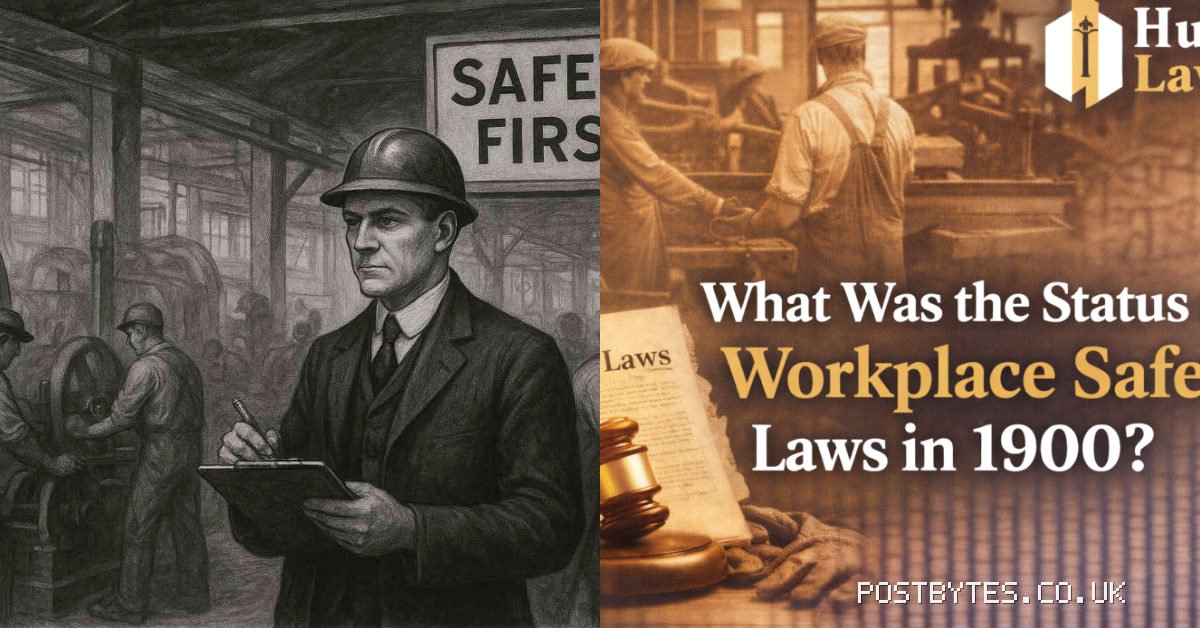
Many assume that workplace safety laws have been a constant feature of American industry, but in 1900, they were almost nonexistent. The federal government had no comprehensive safety legislation, and only a handful of states had enacted limited factory inspection statutes. This article examines the actual status of these laws, who they protected, and the tools used to enforce them.
Who Benefited from the Sparse Safety Laws and Who Was Left Exposed
The few safety laws that existed in 1900 primarily benefited workers in large factories, particularly in the Northeast. States like Massachusetts and New York had passed early factory inspection acts, but these covered only certain industries, such as textiles and manufacturing. Most workers—especially those in mining, railroads, and agriculture—had no legal protection at all.
The losers were the vast majority of laborers. Women and children were often the focus of protective legislation, but adult men faced the highest risks with the least recourse. For example, in the coal mines of Pennsylvania, safety regulations were minimal, and accidents were frequent. Employers bore little liability, as the fellow-servant doctrine and assumption of risk defenses made it difficult for injured workers to win lawsuits.
This imbalance meant that the burden of workplace injuries fell squarely on workers and their families. Without compensation, an injured breadwinner could plunge a household into poverty. The lack of safety laws also meant that employers had no financial incentive to improve conditions, perpetuating a cycle of preventable accidents. A companion read that pairs well with this one is AP Physics 1 Equation Sheet: What It Includes and How to Use It
Tools and Resources Used to Enforce the Limited Regulations
Enforcement relied on a patchwork of state-level factory inspectors, who were often understaffed and underfunded. In Massachusetts, the first state to establish a permanent factory inspection department in 1867, inspectors conducted periodic visits but could only issue warnings or minor fines. They had no authority to shut down dangerous operations.
These reports, such as those from the New York Bureau of Labor Statistics, served as a public record but rarely led to prosecutions. The courts were another resource, but they were largely unsympathetic to workers, applying doctrines that favored employers. Public records covering this story are gathered in What was the status of US Workplace Safety Laws in 1900?
Labor unions, though not a formal enforcement tool, played a crucial role by documenting hazards and lobbying for change. The American Federation of Labor, founded in 1886, pushed for safety legislation, but its influence was limited in 1900. The more effective approach, as later history showed, was federal intervention, which did not arrive until the early 20th century.
Behind the Scenes: How Safety Laws Were Crafted and Why They Were So Weak
The legislative process behind these laws was heavily influenced by industrial interests. State legislators often received campaign contributions from factory owners, who opposed strict regulations. As a result, bills were watered down, and enforcement provisions were gutted.
Another factor was the prevailing legal philosophy of laissez-faire, which held that government should not interfere with contracts between employers and employees. This ideology, championed by courts like the U.S. Supreme Court in cases such as Lochner v. New York (1905), limited the scope of protective legislation. Although Lochner came after 1900, it reflected the judicial mindset of the era.
Public opinion was also divided. While muckraking journalists like Ida Tarbell and Upton Sinclair exposed industrial abuses, their most influential works, such as Sinclair’s The Jungle (1906), came later. In 1900, the public was only beginning to grasp the scale of workplace dangers, and there was little organized pressure for reform.
Deep Dive: Key Events and Figures in the Push for Safety Reforms
One pivotal figure was Florence Kelley, who in 1899 became the first general secretary of the National Consumers League. Kelley campaigned for state laws limiting working hours for women and children, which indirectly improved safety by reducing fatigue-related accidents. Her efforts led to the passage of the Illinois factory inspection law in 1893, which served as a model for other states.
Another milestone was the creation of the U.S. Bureau of Labor Statistics, which began collecting workplace accident data in the 1880s. By 1900, its reports provided the first national picture of industrial injuries, though they were not comprehensive. The bureau’s work laid the groundwork for future federal legislation.
The most significant event after 1900 was the Triangle Shirtwaist Factory fire in 1911, which killed 146 workers and galvanized public opinion. That tragedy led to the enactment of dozens of state safety laws and the establishment of the American Society of Safety Professionals in 1911. While these developments came after 1900, they highlight how weak the earlier laws were.
| Aspect | Status in 1900 |
|---|---|
| Federal laws | None |
| State laws | Only a few states had factory inspection acts |
| Enforcement | Understaffed inspectors, minimal fines |
| Worker compensation | Nonexistent |
| Key reform driver | Triangle Shirtwaist fire (1911) |
Frequently Asked Questions
Is there any federal workplace safety law in effect today that traces back to 1900?
No, the Occupational Safety and Health Act of 1970 is the primary federal law, and it was enacted decades after 1900. It established OSHA, which sets and enforces standards, a stark contrast to the absence of federal oversight in 1900.
What was the first state to pass a factory inspection law?
Massachusetts passed the first comprehensive factory inspection law in 1867, which created a state board to inspect workplaces. This was a pioneering effort, but by 1900, only a few other states had followed suit.
When did workers’ compensation laws become common in the United States?
Workers’ compensation laws began to spread after 1910, with Wisconsin passing the first viable state law in 1911. By 1920, most states had some form of compensation, but in 1900, injured workers had no guaranteed benefits.
Who was Florence Kelley and what role did she play in safety reforms?
Florence Kelley was a social reformer who led the National Consumers League. She advocated for state laws limiting working hours for women and children, which indirectly improved safety, and her work influenced later federal legislation.
What is a good alternative to relying on government inspections for workplace safety?
In 1900, labor unions and investigative journalism served as alternatives, documenting hazards and pressuring employers. Today, voluntary safety programs and industry standards, such as those from ANSI, complement government oversight.
