

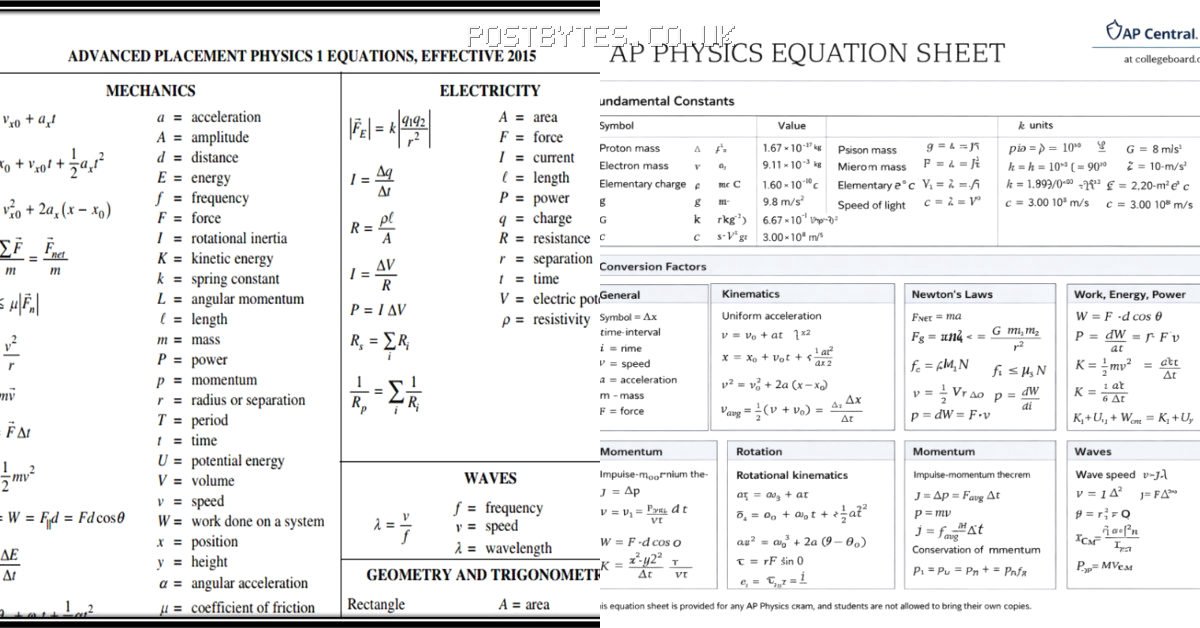
Many students assume they must memorize every formula for the AP Physics 1 exam. That assumption is wrong. The College Board provides a standardized equation sheet inside the exam booklet, so you can focus on applying concepts rather than rote recall.
How the Equation Sheet Evolved from Earlier Physics Exams
The current AP Physics 1 equation sheet traces its roots to the older AP Physics B course, which covered a broader range of topics in a single exam. When the College Board split physics into separate algebra-based and calculus-based courses in 2014, it redesigned the reference materials to match each course’s scope. A companion read that pairs well with this one is How to Safely Remove Fully Embedded Ticks on Dogs at Home
AP Physics 1 is algebra-based, meaning no calculus appears on the sheet. That distinction matters because the equations are simplified versions of more complex calculus-derived formulas. For example, rotational kinematics appear as direct analogs to linear motion equations, with angular displacement replacing linear displacement.
The sheet also reflects the course’s emphasis on conceptual understanding. It lists constants like gravitational acceleration g = 9.8 m/s² and the gravitational constant G = 6.67×10⁻¹¹ N·m²/kg², but it omits derivations. Students are expected to know when to apply each equation, not just how to plug in numbers.
According to some sources, the 2014 redesign aimed to reduce the emphasis on memorization and increase focus on problem-solving. The equation sheet became a tool for reasoning, not a crutch.
What the College Board Regulates About the Equation Sheet
The equation sheet is part of the official exam materials, and its content is strictly controlled by the College Board. You cannot bring your own formula sheet into the testing room; the provided one is the only reference allowed. This policy ensures fairness across all test-takers.
From a regulatory standpoint, the sheet’s format is standardized each year. The PDF version, available on the College Board’s AP Central website, shows the exact layout students will see on exam day.
One legal nuance: the equation sheet is copyrighted material. While students can download and print it for personal study, redistributing it commercially without permission would violate the College Board’s terms. Most schools and tutoring services link to the official PDF rather than hosting copies.
The more useful approach is to practice with the official sheet during mock exams. That way, you learn to locate formulas quickly without wasting time flipping pages. PDF AP Physics 1: Algebra-Based Exam Reference Information keeps a longer factual record of the subject for those who want more
Step-by-Step: How to Use the Equation Sheet Effectively
Start by printing the official PDF and reviewing its structure. The sheet is divided into sections: kinematics, dynamics, energy, momentum, circular motion, simple harmonic motion, waves, and circuits. Each section lists relevant equations with variables defined.
Next, identify which equations you use most often. For kinematics, you’ll rely on v = v₀ + at and x = x₀ + v₀t + ½at². For dynamics, Newton’s second law F = ma is central. Energy problems often require KE = ½mv² and PE = mgh.
Practice applying these to past free-response questions. When you encounter a problem, first identify the physical principle involved, then locate the corresponding equation on the sheet. This two-step process prevents you from grabbing the wrong formula.
One common mistake is using an equation without checking its conditions. For example, the kinematic equations assume constant acceleration. If acceleration changes, those formulas fail. The sheet doesn’t remind you of these limitations, so you must internalize them.
Finally, use the sheet to check units. Each equation’s variables have standard SI units, and verifying that your final units match the expected quantity can catch algebra errors.
Lessons from a Real Exam Incident: When the Sheet Isn’t Enough
In 2019, a student reported on a Reddit thread that they finished the AP Physics 1 exam with time to spare but still scored a 2. Their mistake? They relied on the equation sheet without understanding the underlying concepts. The exam’s free-response questions often require multi-step reasoning, not just formula substitution.
That incident illustrates a key lesson: the equation sheet is a reference, not a substitute for conceptual mastery. The exam tests your ability to choose the right equation, apply it correctly, and interpret the result. A student who memorizes every formula but cannot identify which one applies will struggle.
Another takeaway involves time management. The sheet’s layout is logical, but you still need to know where each equation sits. Students who practice with the sheet under timed conditions report faster navigation and fewer errors.
Ultimately, the sheet levels the playing field. It removes the burden of memorization, but it raises the bar for application. The students who succeed are those who treat the sheet as a map, not a destination.
Frequently Asked Questions
What is the AP Physics 1 equation sheet best known for?
The sheet is best known for being provided in the exam booklet, eliminating the need for memorization. It covers all major topics in the algebra-based course, including mechanics, waves, and circuits, and includes constants like g = 9.8 m/s².
How does the AP Physics 1 equation sheet differ from the AP Physics C sheet?
The AP Physics C sheet includes calculus-based equations, such as those involving derivatives and integrals, because that course is calculus-based. AP Physics 1 uses only algebra, so its sheet has simpler forms, like v = v₀ + at instead of dv/dt = a.
Is it true that the equation sheet is missing some formulas?
Some students claim the sheet omits certain equations, but that’s usually a misunderstanding. The sheet includes all formulas needed for the exam, but it doesn’t list every possible rearrangement. You must know how to manipulate equations algebraically.
When did the College Board introduce the current AP Physics 1 equation sheet?
The current sheet was introduced in 2014, when the College Board launched AP Physics 1 as a separate course. It replaced the older AP Physics B exam, which had a different reference table.
Where can I find the official AP Physics 1 equation sheet?
The official PDF is available on the College Board’s AP Central website. You can also find it in the exam booklet on test day. Teachers often provide copies in class, but the authoritative source is the College Board’s site.
