

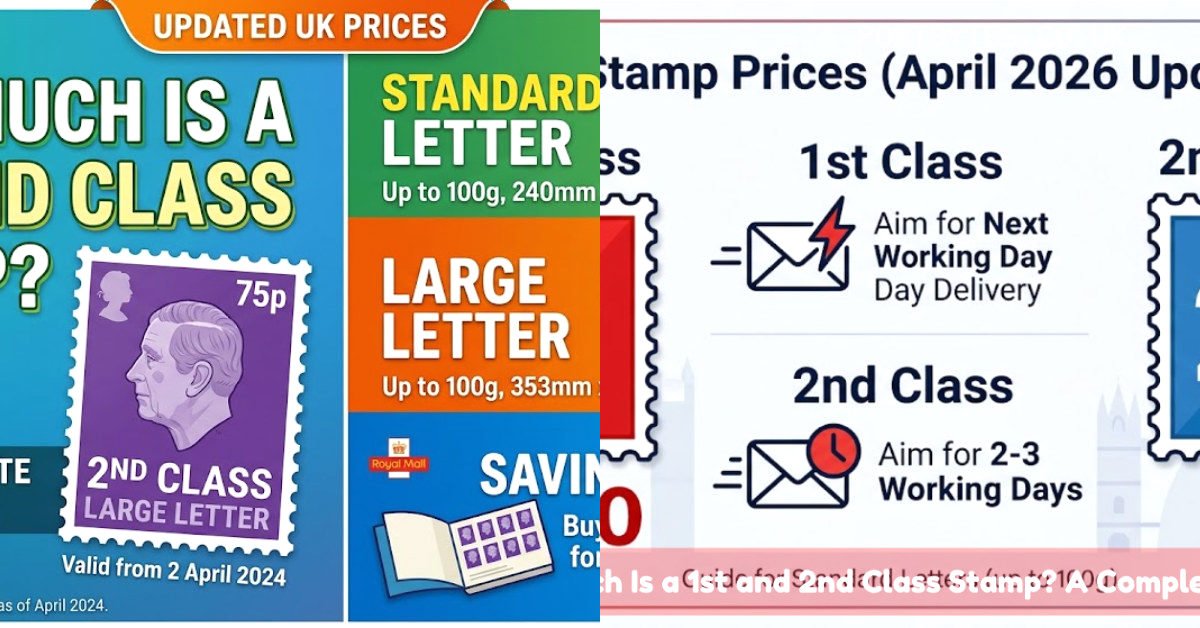
The second class stamp remains the most economical way to send letters within the United Kingdom. As of 2025, Royal Mail sets the price at 85 pence for a standard letter, a figure that has seen steady increases over the past decade. This guide breaks down the current cost, size restrictions, and how second class compares to its faster counterpart.
How Second Class Stamps Compare to First Class and Other Options
Second class postage offers a slower delivery target of three to five working days, while first class aims for next-day delivery. The price gap between the two has widened in recent years, with first class currently costing £1.65 for a standard letter. That difference of 80 pence makes second class attractive for non-urgent mail, such as bills, greeting cards, or small parcels. On a related note, How to Get Something Out of Your Eye: Safe Removal Steps adds helpful background
Royal Mail also provides a large letter rate, which applies to items exceeding the standard letter dimensions. A second class large letter costs £1.55, while the first class equivalent is £2.60. These rates apply to items up to 35.3 cm in length, 25 cm in width, and 2.5 cm in thickness.
For businesses and high-volume senders, the price per stamp drops when purchased in bulk through online postage or franking machines. However, for individual consumers, the 85 pence rate is the standard price at post offices and online.
Tools and Resources for Checking Postage Rates
Royal Mail’s official website provides a postage price finder that calculates the exact cost based on size, weight, and destination. Users input the dimensions and weight of their item, and the tool returns the applicable rate for both first and second class. This resource is particularly useful for those sending unusual items that may fall into the large letter or small parcel categories.
Third-party sites, such as 2ndclassstamp.co.uk, offer quick reference guides and historical price data. These platforms often list the current stamp prices alongside size charts, making it easier to verify the correct postage without navigating Royal Mail’s full tariff table. While such sites are not official, they aggregate publicly available information and can serve as a convenient starting point.
For those who send mail infrequently, a simple kitchen scale and a ruler are sufficient to determine the correct stamp. The key measurements are length, width, and thickness, as exceeding any single dimension pushes the item into a higher price band.
Royal Mail’s Pricing History and the 2025 Adjustment
Royal Mail has raised second class stamp prices almost every year since 2012. In 2022, the price stood at 68 pence, rising to 75 pence in 2023, and then to 85 pence in April 2024. The 2025 price remains at 85 pence, marking the first time in several years that the rate has not increased.
The price of a first class stamp, by contrast, has seen more dramatic jumps. In 2022, it cost 95 pence; by 2024, it had reached £1.35, and in 2025 it stands at £1.65. This widening gap reflects Royal Mail’s strategy to encourage users to shift non-urgent mail to the slower service, thereby reducing operational costs.
According to some sources, the decision to hold the second class price steady in 2025 was influenced by regulatory pressure and public backlash over the rapid increases. The company has also introduced a seasonal surcharge during peak periods, which applies to both classes, though the standard rates remain as stated.
Strengths and Weaknesses of the Second Class Service
The primary strength of second class postage is its cost-effectiveness. For a standard letter, the 85 pence rate is less than half the price of first class, making it the default choice for budget-conscious senders. The service also includes tracking for certain items, such as Signed For, which adds a small fee but provides peace of mind.
However, the delivery target of three to five working days is not guaranteed. Royal Mail states that this is a target, not a commitment, and actual delivery times can vary, especially during busy periods. This unpredictability is a notable weakness for time-sensitive mail, where first class or Special Delivery may be worth the extra cost. A reference profile of the subject is maintained on How much is a UK 2nd Class Stamp?
Another limitation is the size and weight restrictions. A standard letter must weigh no more than 100 grams and fit within the dimensions of 24 cm by 16.5 cm and 0.5 cm thickness. Exceeding these limits requires a large letter stamp, which costs significantly more. For heavier items, the small parcel rate applies, starting at £3.49 for second class.
The more useful approach for most senders is to weigh and measure the item before purchasing a stamp, as overpaying for a larger size is a common mistake. Conversely, underpaying can result in the recipient being asked to pay the difference, which is an inconvenience for both parties.
Frequently Asked Questions
Where can I buy second class stamps at the current price?
Second class stamps are available at all UK post offices, online at Royal Mail’s website, and at many supermarkets and newsagents. The price is the same everywhere, though some retailers may offer discounts for bulk purchases.
When did the price of a second class stamp last change?
The most recent change was in April 2024, when the price rose from 75 pence to 85 pence. As of 2025, the price has remained unchanged, marking a rare year without an increase.
What is the maximum size for a standard letter using a second class stamp?
A standard letter must be no larger than 24 cm in length, 16.5 cm in width, and 0.5 cm in thickness. It must also weigh no more than 100 grams. Items exceeding these dimensions require a large letter stamp.
What is the second class stamp best known for?
The second class stamp is best known for being the cheapest way to send a standard letter within the UK, with a delivery target of three to five working days. It is widely used for non-urgent correspondence such as bills, cards, and personal letters.
How much does it cost to send a large letter second class?
A large letter sent second class costs £1.55, provided it fits within the dimensions of 35.3 cm by 25 cm by 2.5 cm and weighs up to 750 grams. Heavier items fall into the small parcel category, which starts at £3.49.
