

Motherhood is a journey filled with love, sacrifice, patience, and countless moments that shape a family’s life. From comforting a child after a difficult day to offering guidance during important decisions, mothers often provide a steady source of encouragement and support. Yet motherhood can also bring uncertainty, exhaustion, and challenges that are difficult to express.
For Christians, the Bible offers meaningful wisdom about motherhood, family relationships, faith, and the importance of honoring parents. Scripture about mothers can provide comfort during difficult seasons, encouragement for women raising children, and beautiful reminders of the lasting influence a mother’s love can have.
Whether you are searching for a Bible verse to share on Mother’s Day, a meaningful message for your mom, or spiritual encouragement for your own parenting journey, these passages offer valuable lessons about love, wisdom, faith, and family.
Why Is Scripture About Mothers Important?
The Bible presents motherhood as an important responsibility that involves more than providing food, shelter, and everyday care. It also emphasizes teaching, compassion, wisdom, faith, and the influence parents have on their children’s lives.
Several biblical passages specifically address mothers and the relationship between parents and children. Others describe qualities that can encourage women as they raise families, care for loved ones, or navigate the challenges of everyday life.
These verses can be especially meaningful when you want to:
- Express gratitude to your mother.
- Encourage a mother who feels overwhelmed.
- Celebrate motherhood on Mother’s Day.
- Find guidance for raising children with Christian values.
- Remember a mother who has passed away.
- Reflect on the spiritual importance of family relationships.
Understanding the context of each passage helps readers apply its message thoughtfully rather than treating every verse as a general statement about motherhood.
25 Meaningful Bible Verses About Mothers
The following scriptures highlight different aspects of motherhood, including a mother’s love, the importance of wisdom, the value of teaching children, and the biblical command to honor parents. Wording may vary slightly depending on the Bible translation.
1. Proverbs 31:28 — A Mother’s Children Rise Up and Call Her Blessed
Proverbs 31:28 describes children rising up and calling their mother blessed, while her husband also praises her.
This verse is a beautiful reminder that a mother’s dedication deserves recognition. The passage appears within a larger description of a woman known for wisdom, generosity, diligence, and care for her household.
Why it matters: It encourages families to express appreciation for their mothers rather than assuming their sacrifices are understood. A sincere thank-you, a thoughtful conversation, or practical help can communicate that appreciation in everyday life.
2. Exodus 20:12 — Honor Your Father and Mother
Exodus 20:12 contains one of the Ten Commandments: honor your father and your mother.
This commandment emphasizes the importance of respecting parents and recognizing their place within family life. Honoring a mother can include speaking to her respectfully, appreciating her efforts, listening to her wisdom, and caring for her when she needs support.
Honoring a parent does not mean pretending that every family relationship is healthy or that harmful behavior must be accepted. Respect can coexist with appropriate boundaries when a relationship is difficult.
3. Proverbs 1:8 — Listen to Your Mother’s Teaching
Proverbs 1:8 encourages readers to listen to their father’s instruction and not forsake their mother’s teaching.
This verse recognizes that mothers can play an important role in shaping a child’s character. Lessons about honesty, kindness, responsibility, and compassion often begin at home long before children understand their wider significance.
A mother’s guidance may influence how her children approach relationships, respond to challenges, and make decisions throughout adulthood.
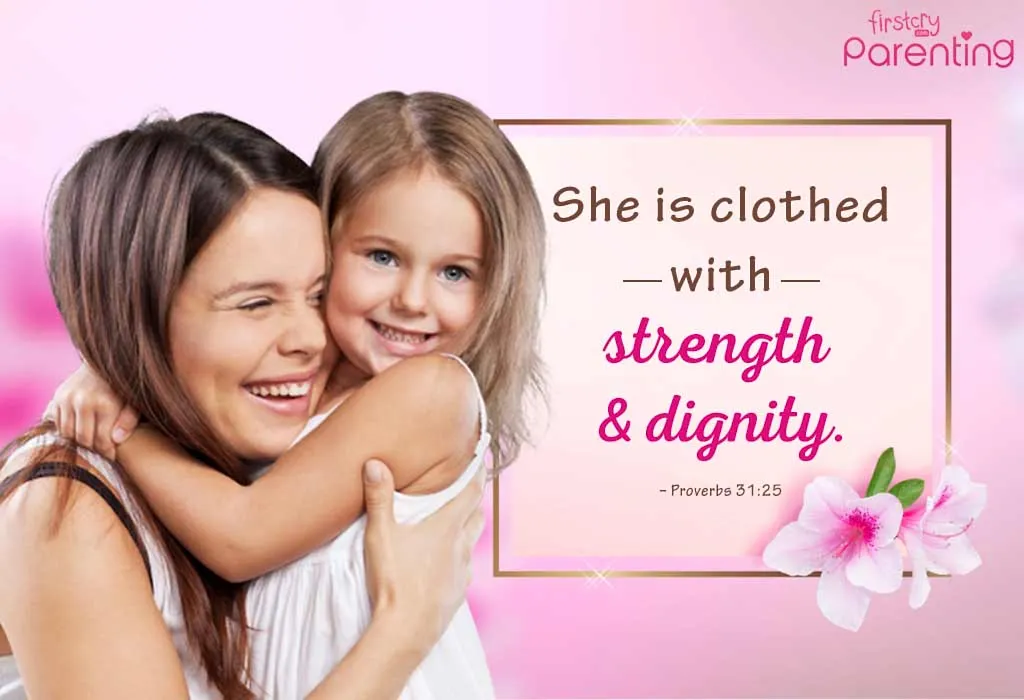
4. Proverbs 31:25 — Strength and Dignity
Proverbs 31:25 describes a woman clothed with strength and dignity who can face the future with confidence.
Although this verse is not exclusively about mothers, it is often meaningful to women balancing family responsibilities with personal growth and faith.
Motherhood requires many forms of strength. Sometimes that strength looks like making difficult decisions. At other times, it means asking for help, admitting uncertainty, or showing patience when life does not go according to plan.
The verse offers an encouraging picture of strength grounded in character rather than perfection.
5. Isaiah 66:13 — Comfort Like a Mother
Isaiah 66:13 uses the image of a mother comforting her child to describe God’s comfort for His people.
This passage offers a powerful connection between the familiar tenderness of maternal care and the reassurance of divine compassion.
For mothers who feel emotionally exhausted, the verse can serve as a reminder that they, too, need comfort and support. Caring for others does not eliminate the need to receive care themselves.
It can also encourage family members to become a source of reassurance for mothers who are navigating grief, stress, or uncertainty.
6. Proverbs 31:26 — Wisdom and Kindness
Proverbs 31:26 says that a woman opens her mouth with wisdom and that the teaching of kindness is on her tongue.
This scripture highlights the influence of a mother’s words. Children often remember not only what their mothers teach them but also how those lessons are communicated.
Patient explanations, honest conversations, gentle correction, and words of encouragement can help children develop confidence and emotional maturity.
The verse also reminds mothers that wisdom and kindness belong together. Guidance is often most effective when children feel respected and understood.
7. 2 Timothy 1:5 — The Faith of Lois and Eunice
In 2 Timothy 1:5, Paul recalls the sincere faith that lived first in Timothy’s grandmother Lois and his mother Eunice.
This passage offers a specific biblical example of faith being passed from one generation to another. It acknowledges the spiritual influence of women within Timothy’s family.
Their example is especially encouraging for mothers and grandmothers who want to share their beliefs with younger generations.
Faith is often communicated through ordinary actions: praying together, demonstrating compassion, practicing forgiveness, and showing how biblical principles can influence everyday decisions.
8. Proverbs 6:20 — Do Not Forsake Your Mother’s Teaching
Proverbs 6:20 encourages readers to keep their father’s commandment and not forsake their mother’s teaching.
The verse reinforces the importance of remembering the guidance received during childhood. A mother’s lessons may continue to influence her children long after they leave home.
For adults reflecting on their upbringing, this passage can inspire gratitude for valuable lessons and thoughtful consideration of the wisdom that remains relevant in their lives.
9. Deuteronomy 5:16 — Honor Your Parents
Deuteronomy 5:16 repeats the command to honor one’s father and mother, connecting it with the well-being of the community and the life of the people of Israel.
Its message reinforces the importance of family responsibility and respect across generations.
For modern readers, honoring a mother might mean making time for meaningful conversations, remembering important occasions, offering practical assistance, or acknowledging the work she has done throughout her life.
10. Psalm 139:13–14 — Wonderfully Made
Psalm 139:13–14 describes God’s involvement in forming a person and expresses wonder at the marvelous nature of His creation.
Although these verses are not specifically about mothers, they can be meaningful during pregnancy, childbirth, and the early years of raising a child.
They invite reflection on the value of human life and the wonder associated with a child’s development.
For expectant mothers and parents welcoming a newborn, this passage can provide a spiritual framework for gratitude and appreciation.
11. 1 Samuel 1:27–28 — Hannah’s Prayer for a Child
In 1 Samuel 1:27–28, Hannah explains that she prayed for a son and that God granted her request. She then dedicates Samuel to the Lord’s service.
Hannah’s story includes years of longing, heartfelt prayer, and a significant decision about her son’s future.
Her experience can resonate with women who have faced uncertainty, infertility, or difficult decisions related to parenthood. It also illustrates that biblical accounts of motherhood include complex emotions rather than only uncomplicated happiness.
Readers should approach Hannah’s story as a specific account of faith, not as a guarantee that every prayer for a child will be answered in the same way.
12. Luke 1:46–49 — Mary’s Song of Praise
Luke 1:46–49 records part of Mary’s song of praise, commonly known as the Magnificat, in which she glorifies God and reflects on His regard for her.
Mary’s experience as the mother of Jesus occupies a central place in the Christian story. Her response expresses humility, faith, and gratitude.
For Christian mothers, these verses can Scripture About Mothers encourage reflection on trusting God during uncertain circumstances and recognizing that a meaningful life of faith may involve responsibilities that are not always easy to understand.
13. Luke 2:19 — Mary Treasured These Things
Luke 2:19 describes Mary treasuring the events surrounding Jesus’ birth and pondering them in her heart.
This short verse offers a gentle picture of a mother reflecting on extraordinary experiences in her child’s life.
Parenthood contains countless moments that may seem ordinary at first but become precious with time. A child’s first words, a family celebration, a difficult conversation, or a quiet moment together can become part of a family’s lasting memories.
Mary’s example invites readers to make room for reflection amid the busyness of daily responsibilities.
14. Ephesians 6:1–3 — Children and Parents
Ephesians 6:1–3 instructs children to obey their parents in the Lord and repeats the commandment to honor father and mother.
The passage places family relationships within a broader discussion of Christian conduct.
For mothers, it can provide an opportunity to reflect on the relationship between parental guidance and children’s growing independence. Teaching respect is important, but healthy family relationships also benefit from listening, mutual understanding, and age-appropriate responsibility.
The passage should be read alongside Ephesians 6:4, which tells fathers not to provoke their children to anger and instead to raise them with instruction and discipline rooted in the Lord.
Together, these verses emphasize responsibilities on both sides of the parent-child relationship.
15. Titus 2:3–5 — Teaching What Is Good
Titus 2:3–5 discusses older women teaching what is good and encouraging younger women in family and personal responsibilities.
The passage highlights the value of intergenerational guidance and practical wisdom within the Christian community.
Experienced mothers can offer valuable encouragement to women entering motherhood for the first time. Support may involve sharing lessons learned, providing reassurance during difficult days, or simply listening without judgment.
The broader lesson is that mothers do not have to navigate every challenge alone. Healthy communities can help families grow through shared experience, encouragement, and care.
16. Galatians 6:9 — Do Not Grow Weary in Doing Good
Galatians 6:9 encourages believers not to become weary in doing good, because a harvest will come in due time if they do not give up.
While the verse is not specifically about parenting, its message can be deeply relevant to motherhood.
Many of the most important parenting responsibilities produce no immediate reward. Teaching a child patience, encouraging honesty, maintaining consistent routines, and modeling compassion require repeated effort.
The verse offers encouragement to mothers who wonder whether their everyday work makes a difference. It invites perseverance while recognizing that growth often takes time.
17. Philippians 4:6–7 — Peace During Worry
Philippians 4:6–7 encourages believers to bring their requests to God through prayer and thanksgiving, describing the peace of God that guards hearts and minds.
Motherhood can involve concerns about a child’s health, education, friendships, safety, and future. Even loving and attentive parents cannot control every circumstance.
These verses can encourage mothers to express their worries honestly in prayer rather than feeling that they must carry every concern alone.
Prayer does not remove every practical challenge, but it can be part of a broader approach that includes seeking trusted advice, accepting help, and taking constructive steps when problems arise.
18. Psalm 127:3 — Children Are a Heritage From the Lord
Psalm 127:3 describes children as a heritage from the Lord and the fruit of the womb as a reward.
This verse presents children as valuable gifts within the biblical understanding of family.
It can encourage parents to view their children as individuals deserving love, guidance, patience, and respect. Children are not projects to perfect or achievements to display. They are people who need opportunities to learn, grow, and develop their own gifts.
The passage can be especially meaningful when celebrating a birth or reflecting on the responsibilities of raising a family.
19. 1 Corinthians 13:4–7 — The Nature of Love
First Corinthians 13:4–7 describes love as patient and kind, not envious or boastful, and as enduring through difficulties.
Although this passage is often read at weddings, its description of love is also relevant to motherhood.
Patience can mean giving a child time to learn. Kindness can mean correcting a mistake without humiliation. Perseverance can mean remaining committed to a child’s well-being through challenging seasons.
The passage does not suggest that mothers must tolerate abuse or never experience frustration. Instead, it offers a picture of love that values patience, truth, and the well-being of others.
20. Colossians 3:21 — Do Not Discourage Your Children
Colossians 3:21 warns parents against discouraging their children.
This verse provides an important reminder that parental authority should not be used in ways that crush a child’s spirit.
Children need boundaries, correction, and guidance, but they also need encouragement and the opportunity to learn from mistakes.
A mother can apply this principle by recognizing effort, listening carefully, explaining expectations, and distinguishing between a child’s behavior and the child’s worth as a person.
21. Proverbs 22:6 — Train Up a Child
Proverbs 22:6 teaches the importance of training a child in the way he or she should go, using the traditional wording found in many translations.
The verse is frequently discussed in conversations about Christian parenting and moral education.
It encourages parents to take an active role in helping children develop habits, values, and practical skills. Consistency matters because children often learn through repeated examples rather than isolated instructions.
However, Proverbs is a book of wisdom, not a formula guaranteeing that every child will make the same choices as an adult. Parents can offer guidance and support, but children also develop their own judgment and make their own decisions.
22. James 1:5 — Ask God for Wisdom
James 1:5 encourages anyone who lacks wisdom to ask God, who gives generously.
This verse can be particularly reassuring for mothers facing unfamiliar challenges.
No parent has every answer. Decisions about discipline, schooling, relationships, health, and family responsibilities may require careful thought and advice from trustworthy people.
Seeking wisdom can involve prayer, learning from experience, asking questions, and considering the needs of everyone involved.
The verse reminds mothers that uncertainty does not mean failure. It can be an invitation to seek guidance with humility and faith.
23. Isaiah 40:31 — Renewed Strength
Isaiah 40:31 describes those who hope in the Lord as receiving renewed strength, using imagery of rising on wings like eagles.
The passage speaks to people who feel weary and need renewed confidence in God.
For mothers dealing with demanding schedules, family pressures, or a season of change, this scripture can serve as a reminder to seek spiritual renewal.
Rest, supportive relationships, prayer, and reasonable expectations can all help mothers care for themselves while continuing to care for others.
24. Romans 12:10 — Honor One Another
Romans 12:10 encourages believers to love one another deeply and to honor others.
Although the verse addresses Christian relationships broadly, it provides a useful principle for appreciating mothers.
Honor does not need to be limited to birthdays or Mother’s Day. It can be expressed through everyday courtesy, thoughtful communication, and a willingness to recognize another person’s contributions.
For adult children, this may mean setting aside time for a conversation or acknowledging the ways their mother has influenced their lives.
For families with complicated histories, honor can also involve responding with maturity while maintaining boundaries that protect everyone’s well-being.
25. Psalm 46:1 — God Is Our Refuge and Strength
Psalm 46:1 describes God as a refuge and strength, an ever-present help in trouble.
This passage is not exclusively about motherhood, but it can offer encouragement to mothers facing circumstances beyond their control.
A mother may experience grief, financial pressure, family conflict, or concern for a child. During such times, the verse points toward the biblical theme of finding strength and refuge in God.
It can be a comforting passage to include in a prayer, a handwritten note, or a message to a mother who needs reassurance.
What Does the Bible Say About a Mother’s Love?
The Bible presents parental love through several related themes: compassion, instruction, sacrifice, encouragement, and responsibility.
Isaiah 66:13 uses a mother’s comforting care as an image of God’s comfort. Proverbs 31 describes a woman whose wisdom and work benefit her household and community. Meanwhile, 1 Corinthians 13 explains the qualities of love that apply to relationships throughout life.
Taken together, these passages suggest that love is more than an emotion. It is demonstrated through consistent care, thoughtful choices, patience, and concern for another person’s well-being.
A mother’s love may look different in different families. Some mothers express affection through conversation and physical closeness, while others show it through practical help, reliability, or quiet acts of service.
Scripture can encourage appreciation for these different expressions of care without suggesting that every mother or family relationship is the same.
Bible Verses for Mother’s Day
Mother’s Day is an opportunity to recognize the women who have offered care, guidance, and encouragement. Choosing a Bible verse for the occasion can make a card, letter, or personal message more meaningful.
Here are five especially suitable choices:
- Proverbs 31:28: A meaningful choice for expressing gratitude and appreciation.
- Isaiah 66:13: Suitable for a message centered on comfort and tenderness.
- 2 Timothy 1:5: A thoughtful verse for honoring a mother’s or grandmother’s spiritual influence.
- Proverbs 31:26: Ideal for recognizing a woman’s wisdom and kindness.
- Psalm 127:3: Appropriate for celebrating children and family life.
When choosing a verse, consider your mother’s personality and the nature of your relationship. A short message that connects scripture with a genuine memory or expression of gratitude often feels more personal than a long collection of quotations.
For example, you might write that Proverbs 31:26 reminds you of the wise and kind advice your mother has given you over the years.
Scripture for Mothers Who Need Encouragement
Not every season of motherhood feels joyful. Some mothers experience exhaustion, loneliness, uncertainty, or disappointment while trying to meet their family’s needs.
The Bible includes passages that can help readers reflect on perseverance, wisdom, peace, and the importance of seeking support.
When motherhood feels overwhelming
Galatians 6:9 encourages perseverance in doing good. It can remind mothers that meaningful work often develops gradually and that one difficult day does not define an entire parenting journey.
When you are worried about your children
Philippians 4:6–7 offers a reminder to bring concerns to God through prayer. Mothers can combine this spiritual practice with practical steps such as talking with teachers, consulting qualified professionals, or asking trusted family members for help.
When you need wisdom
James 1:5 encourages believers to seek wisdom from God. This is especially relevant when parenting decisions seem complicated or when a mother is unsure how best to support her child.
When you feel exhausted
Isaiah 40:31 offers imagery of renewed strength. The verse can encourage spiritual reflection while reminding mothers that rest and assistance are important parts of sustaining their well-being.
These scriptures are not promises that every difficulty will disappear immediately. Rather, they provide themes of hope and guidance that Christians can return to during challenging periods.
How to Use Bible Verses About Mothers in Everyday Life
Reading scripture can be meaningful on its own, but applying its lessons to everyday relationships can make the experience more practical.
Write a personal note. Choose a verse that reflects your mother’s character and explain why it reminds you of her. A personal memory can make the message especially meaningful.
Include a passage in a prayer. Use a verse about wisdom, comfort, or strength as a starting point for praying for your mother or for your own responsibilities as a parent.
Read together as a family. Discuss a passage such as Proverbs 1:8 or Ephesians 6:1–4 and talk about how respect, listening, and encouragement work in both directions.
Encourage a new mother. A short message featuring Isaiah 40:31 or James 1:5 can offer spiritual encouragement without implying that she must handle every challenge perfectly.
Remember a mother who has passed away. A comforting passage, such as Psalm 46:1, may provide a starting point for reflection, prayer, or a family remembrance. Grief is personal, and it is important to allow room for different emotions rather than expecting a single verse to remove sadness.
The most helpful approach is to choose scripture that genuinely fits the situation and communicate its message with sensitivity.
Frequently Asked Questions About Scripture About Mothers
What is the best Bible verse about mothers?
Proverbs 31:28 is one of the most popular choices because it describes children rising up to call their mother blessed. It is particularly suitable for expressing appreciation and recognizing a mother’s contributions to her family.
Other meaningful options include Isaiah 66:13, which uses the image of maternal comfort, and Proverbs 31:26, which highlights wisdom and kindness.
What does Proverbs 31:28 say about mothers?
Proverbs 31:28 describes children rising up and calling their mother blessed, with her husband praising her as well. The verse appears in a passage celebrating a woman’s wisdom, character, generosity, and diligence.
It is often used to express gratitude for a mother’s dedication and influence.
What scripture says to honor your mother?
Exodus 20:12 and Deuteronomy 5:16 both command people to honor their father and mother. Ephesians 6:1–3 also repeats this principle in its discussion of family relationships.
These passages emphasize respect for parents and the importance of recognizing family responsibilities.
What Bible verse describes a mother’s love?
Isaiah 66:13 uses the image of a mother comforting her child to describe God’s comfort for His people. First Corinthians 13:4–7 also describes patience, kindness, and perseverance, qualities that can help explain how love is expressed in everyday family life.
What is a good Bible verse for a new mom?
James 1:5 is a useful choice because it encourages people to ask God for wisdom. Isaiah 40:31 can also provide encouragement to a new mother who feels tired or uncertain.
These passages offer spiritual themes of guidance and renewed strength without suggesting that motherhood must always feel easy.
What does the Bible say about a mother’s role?
The Bible presents several dimensions of parental responsibility, including teaching, providing guidance, demonstrating faith, and caring for children. Proverbs 1:8 emphasizes a mother’s teaching, while 2 Timothy 1:5 highlights the influence of a mother and grandmother on Timothy’s faith.
Biblical passages also discuss parental responsibility more broadly, so motherhood should be understood within the wider themes of family care, wisdom, and mutual respect.
Is there a Bible verse for Mother’s Day?
Proverbs 31:28 is a popular choice for Mother’s Day because it celebrates appreciation for a mother’s character and efforts. Isaiah 66:13 and Proverbs 31:26 are also suitable options for messages focused on comfort, kindness, and wisdom.
The best verse depends on the message you want to communicate.
What Bible verse can comfort a grieving mother?
Psalm 46:1 describes God as a refuge and strength in times of trouble. Philippians 4:6–7 offers a message about prayer and God’s peace.
When comforting a grieving mother, share scripture gently and allow her to express her feelings. Compassionate presence and practical support can be just as important as the words you choose.
What does the Bible say about mothers teaching their children?
Proverbs 1:8 and Proverbs 6:20 both emphasize listening to a mother’s teaching. Proverbs 22:6 is also frequently discussed in relation to guiding children as they grow.
Together, these passages highlight the importance of consistent instruction, wise guidance, and the example parents set through their actions.
Can Bible verses about mothers be used for a memorial?
Yes. Passages about comfort, faith, love, and strength can be Scripture About Mothers included in a memorial program, sympathy card, family remembrance, or personal reflection.
Psalm 46:1 and Isaiah 66:13 may be particularly meaningful for some readers. Choose a passage that reflects the family’s beliefs and the circumstances of the loss, and remember that grief deserves patience and understanding.
Conclusion: Finding Meaning in Scripture About Mothers
Scripture about mothers offers meaningful reminders of the importance of love, wisdom, faith, and family relationships. From Proverbs 31:28, which celebrates a mother’s contributions, to Isaiah 66:13, which uses maternal comfort as an image of God’s care, these passages provide encouragement for many different seasons of life.
Some verses are especially suitable for Mother’s Day cards and messages of gratitude. Others offer guidance for raising children, seeking wisdom, persevering through challenges, or finding comfort during grief.
The most meaningful way to use these scriptures is to consider their context and apply their lessons with sincerity. A thoughtful message, a moment of prayer, or a simple expression of appreciation can help bring biblical teachings into everyday life.
Motherhood does not require perfection. It involves learning, caring, making difficult decisions, and continuing to grow. For readers seeking spiritual guidance, the Bible provides enduring themes of compassion, encouragement, and faith that can help families recognize the value of mothers and the importance of caring for one another.
