

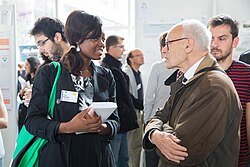
Henri Kagan is a French chemist whose career has had a lasting influence on modern organic chemistry. For decades, his name has been closely associated with asymmetric catalysis, stereochemistry, and the challenge of controlling which three-dimensional form of a molecule is produced during a chemical reaction.
That work became even more prominent on October 7, 2026, when Henri B. Kagan and Japanese chemist Kenso Soai were awarded the 2026 Nobel Prize in Chemistry for the discovery of nonlinear effects and autocatalysis in asymmetric organic synthesis. The Royal Swedish Academy of Sciences recognized research that helped deepen scientists’ understanding of how chemical reactions can favor one molecular mirror image over another.
For people outside chemistry, the subject can sound highly specialized. Yet the underlying problem is surprisingly intuitive: some molecules exist in left- and right-handed forms, much like human hands. These forms can behave differently in biological systems, making the ability to selectively create one form extremely important in medicine and chemical manufacturing.
Who Is Henri Kagan?
Henri Boris Kagan is a French organic chemist born on December 15, 1930, in Boulogne-Billancourt, France. He studied at the Sorbonne and the École Henri Kagan nationale supérieure de chimie de Paris before completing doctoral work at the Collège de France under Jean Jacques. He later developed a long academic career at what became Université Paris-Sud in Orsay.
Kagan eventually became professor emeritus at Université Paris-Sud and was elected to the French Academy of Sciences in 1991. His scientific career has covered organic chemistry, organometallic chemistry, stereochemistry, and asymmetric synthesis.
Rather than focusing on a single isolated chemical reaction, Kagan’s research addressed a much broader question: how can chemists design reactions that consistently produce a desired molecular configuration?
That question became one of the central challenges of modern synthetic chemistry.
Why Molecular “Handedness” Matters
To understand Henri Kagan’s importance, it helps to understand chirality.
A chiral molecule has a structure that cannot simply be superimposed on its mirror image. The classic analogy is a pair of hands. A left hand and a right hand look similar, but they cannot be perfectly aligned on top of each other.
Chemists refer to these mirror-image molecules as enantiomers. They can have very different interactions with other chiral molecules, including biological receptors and enzymes.
This distinction is especially important in pharmaceuticals. A drug molecule with one spatial arrangement can interact with the body differently from its mirror-image counterpart. Consequently, chemists need reliable methods for controlling molecular orientation during synthesis.
This is where asymmetric synthesis becomes important.
What Is Asymmetric Catalysis?
Asymmetric catalysis is a branch of chemistry concerned with using a catalyst to favor the formation of one enantiomer over its mirror image.
A catalyst helps a chemical reaction occur without being consumed in the overall process. In asymmetric catalysis, the catalyst has a three-dimensional structure that can influence which molecular arrangement is formed.
The goal is not simply to make a chemical reaction faster. It is to make it more selective.
That selectivity can reduce the need for later separation and purification, making chemical synthesis more efficient and potentially more practical on an industrial scale.
The Franklin Institute recognized Kagan as a pioneer of asymmetric catalysis, specifically citing his work on chemical principles showing how catalyst shape can control chemical reactions and simplify the manufacture of pharmaceutically important compounds.
Henri Kagan and the Development of Chiral Catalysts
One of Henri Kagan’s best-known contributions is his work on chiral ligands used in asymmetric catalysis.
A ligand is a molecule that can bind to a metal center and influence the behavior of the resulting chemical complex. By designing a ligand with an appropriate three-dimensional structure, chemists can create an environment that favors formation of one molecular configuration.
Kagan’s work helped establish the importance of molecular architecture and symmetry in designing such systems.
Among the most influential developments associated with his research is DIOP, a chiral phosphine ligand that became an important example in asymmetric hydrogenation. His broader research program helped demonstrate that stereochemical control could be approached systematically rather than treated simply as an experimental trial-and-error exercise.
This was an important conceptual shift. Instead of asking only whether a reaction could occur, researchers could increasingly ask how the catalyst’s structure could determine the outcome.
The Importance of DIOP
DIOP is particularly significant in the history of asymmetric hydrogenation.
Asymmetric hydrogenation involves adding hydrogen to an unsaturated molecule while controlling the three-dimensional configuration of the resulting product. With an appropriate chiral catalyst, the reaction can favor one enantiomer.
Kagan’s research on DIOP helped demonstrate the potential of chiral ligand design for achieving this kind of selectivity.
The importance of this work extends beyond one compound or one reaction. It contributed to a broader understanding of how catalysts can be engineered to influence stereochemistry.
That principle is now fundamental to many areas of modern synthetic chemistry.
Henri Kagan’s Work on Nonlinear Effects
Another major part of Kagan’s scientific legacy involves nonlinear effects in asymmetric catalysis.
In a simple chemical system, researchers might expect the relationship between catalyst composition and product composition to behave in a relatively straightforward way. But Kagan’s research showed that asymmetric catalytic systems can display more complicated behavior.
In certain circumstances, a small change in the proportion of one chiral component can produce a disproportionately large change in the stereochemical composition of the product.
These nonlinear effects became an important area of research because they provided clues about how molecules interact within catalytic systems.
Kagan’s research in this area dates back to the 1980s. His work helped establish mathematical and experimental approaches for understanding these unexpected relationships.
Why Kagan’s Research Matters to the 2026 Nobel Prize
The 2026 Nobel Prize in Chemistry recognized Henri Kagan and Kenso Soai for discoveries concerning nonlinear effects and autocatalysis in asymmetric organic synthesis.
Autocatalysis describes a situation in which a reaction product can help promote the same reaction that produced it.
This creates an intriguing possibility: a small initial imbalance between two molecular mirror images can potentially become amplified through chemical processes.
The subject connects to one of chemistry’s longstanding questions—why biological systems overwhelmingly use particular molecular orientations rather than an equal mixture of mirror-image forms.
The phenomenon is known as homochirality.
Although the origins of life’s molecular handedness remain a complex scientific question, research into asymmetric reactions and autocatalysis provides important tools for investigating how chemical systems can develop and amplify asymmetry.
Henri Kagan and Kenso Soai
The Nobel recognition also highlights the connection between Kagan’s foundational research and Kenso Soai’s later experimental achievements.
Kagan investigated nonlinear behavior in asymmetric catalysis, helping scientists understand how catalyst composition and stereochemical outcomes could be connected.
Soai later became famous for the development of an autocatalytic chemical reaction capable of producing and amplifying molecular asymmetry.
Together, their contributions helped advance understanding of how chemical systems can move away from an initially balanced state and favor one molecular handedness.
The Nobel Committee described the discoveries as foundational chemistry with particular importance for understanding molecular asymmetry and its applications.
Applications in Pharmaceuticals
One reason asymmetric synthesis matters so much is its relevance to pharmaceutical chemistry.
Biological systems are inherently three-dimensional and highly selective. Enzymes, receptors, proteins, and other biological structures can distinguish between molecules that have the same atoms but different spatial arrangements.
As a result, controlling stereochemistry can be essential when developing medicines.
The significance is not limited to pharmaceuticals. Asymmetric chemistry can also influence the synthesis of compounds used in fragrances, flavors, agricultural chemicals, and advanced materials.
The Franklin Institute’s description of Kagan’s work specifically emphasizes its importance for the manufacture of pharmaceutically relevant compounds.
Modern drug discovery therefore benefits from principles developed through decades of research into stereoselective and asymmetric synthesis.
Henri Kagan’s Academic Legacy
Kagan’s influence extends beyond individual chemical discoveries.
Throughout his career, he worked as Henri Kagan a researcher, professor, author, and mentor. The Franklin Institute noted that after nearly four decades at Université Paris-Sud, he continued contributing as an emeritus professor, visiting lecturer, author, and mentor to younger chemists.
His research record includes hundreds of scientific publications, while professional organizations have recognized him with numerous major awards.
Among those honors are the Wolf Prize in Chemistry, the Prelog Medal, the Tetrahedron Prize for Creativity in Organic Chemistry, and the Bower Award and Prize for Achievement in Science.
His election to the French Academy of Sciences in 1991 further reflects his standing within the international scientific community.
What Makes Henri Kagan’s Work Different?
Kagan’s career illustrates an important feature of fundamental science: a discovery does not always have to produce an immediate consumer product to become enormously influential.
His research addressed underlying principles of chemical selectivity.
By investigating catalyst structure, molecular symmetry, asymmetric reactions, and nonlinear behavior, Kagan helped create a framework that other researchers could build upon.
That framework is valuable because chemistry is not simply about producing molecules. It is also about producing the right molecule, in the right form, efficiently and predictably.
That distinction becomes particularly important when the molecules being produced interact with biological systems.
Frequently Asked Questions About Henri Kagan
Who is Henri Kagan?
Henri Kagan is a French chemist best known for pioneering research in asymmetric catalysis, stereochemistry, and asymmetric organic synthesis. He was a professor emeritus at Université Paris-Sud and a member of the French Academy of Sciences.
Why is Henri Kagan famous?
Henri Kagan is famous for influential contributions to asymmetric catalysis, including work on chiral ligands, asymmetric hydrogenation, and nonlinear effects in asymmetric catalytic reactions.
Did Henri Kagan win the 2026 Nobel Prize in Chemistry?
Yes. Henri B. Kagan and Kenso Soai received the 2026 Nobel Prize in Chemistry for the discovery of nonlinear effects and autocatalysis in asymmetric organic synthesis.
What did Henri Kagan contribute to asymmetric catalysis?
Kagan made major contributions to understanding how chiral catalyst structures can control the stereochemical outcome of chemical reactions. His research helped advance asymmetric hydrogenation and the broader design of enantioselective catalytic systems.
What is the Kagan DIOP ligand?
DIOP is a chiral phosphine ligand associated with Kagan’s work in asymmetric catalysis. It became an influential example of how ligand design can help control stereochemistry during catalytic reactions.
What are nonlinear effects in asymmetric catalysis?
Nonlinear effects occur when the relationship between the composition of a chiral catalyst system and the resulting product’s enantiomeric composition is not proportional. Such behavior can reveal important information about interactions within catalytic systems.
What is autocatalysis?
Autocatalysis occurs when a product of a chemical reaction helps catalyze or promote further formation of that product. In asymmetric chemistry, autocatalysis can potentially amplify a small initial imbalance between molecular mirror images.
Why is asymmetric synthesis important?
Asymmetric synthesis allows chemists to preferentially produce one enantiomer rather than an equal mixture of mirror-image molecules. This is particularly important in pharmaceutical chemistry because biological systems can respond differently to different molecular configurations.
Where did Henri Kagan study?
Kagan studied at the Sorbonne and the École nationale supérieure de chimie de Paris. He completed his doctoral work at the Collège de France under Jean Jacques.
What is Henri Kagan’s broader scientific legacy?
Kagan’s broader legacy is his role in turning asymmetric catalysis into a more systematic field of chemical research. His work connected catalyst architecture, molecular symmetry, stereochemical selectivity, and nonlinear behavior, influencing generations of researchers.
Conclusion
Henri Kagan’s scientific career illustrates how fundamental chemistry can influence fields far beyond the laboratory.
His research into asymmetric catalysis helped chemists better understand how molecular structure can determine the outcome of chemical reactions. His work with chiral ligands and asymmetric synthesis contributed to methods that are important for producing biologically relevant compounds, while his research into nonlinear effects opened new ways of thinking about how molecular asymmetry can be amplified.
The 2026 Nobel Prize in Chemistry places that decades-long body of work in a new spotlight. Together with Kenso Soai, Kagan was recognized for discoveries that helped illuminate nonlinear effects and autocatalysis in asymmetric organic synthesis.
For anyone interested in modern chemistry, Henri Kagan’s story is ultimately about a deceptively simple idea: molecules can have handedness, and controlling that handedness can have enormous scientific and practical consequences.

1 Comment
Pingback: Did the Brewers Win Last Night? Milwaukee Brewers vs. Padres Result